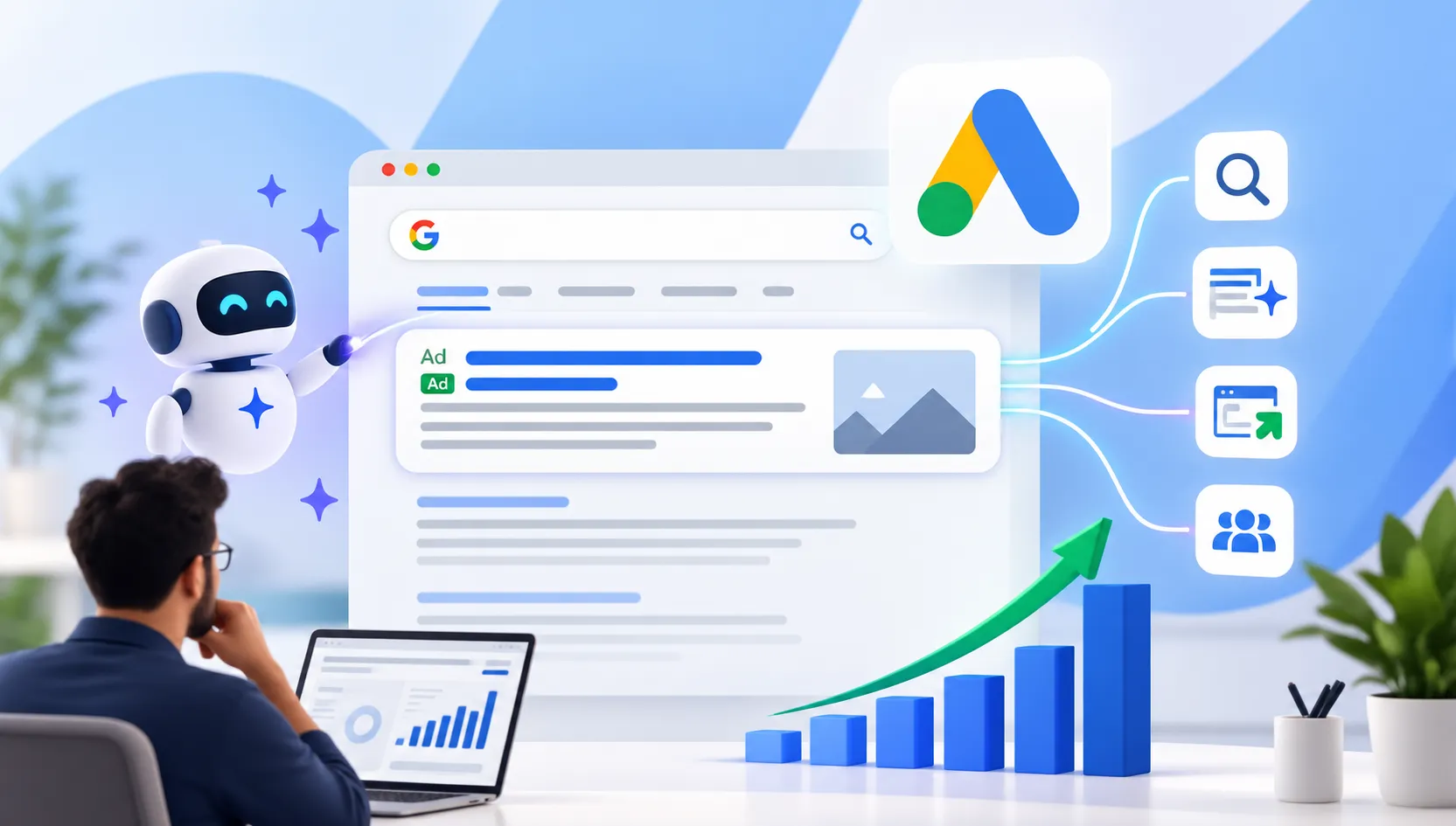

Google Ads is changing quickly as AI becomes a bigger part of Search advertising. One of the most important developments is AI Max for Search campaigns, a set of AI-powered features designed to help advertisers discover additional search opportunities, create more relevant ad variations, and connect users with more relevant landing pages.
For businesses already running Google Search campaigns, AI Max is worth understanding—not simply because it uses AI, but because it changes how advertisers can manage targeting, ad assets, and campaign expansion.
What Is Google Ads AI Max?
AI Max for Search campaigns is an optimization layer within existing Search campaigns, not a separate campaign type. It combines several AI-powered targeting and creative features to help advertisers reach additional relevant searches while maintaining controls over campaign performance and relevance.
Depending on the features enabled, AI Max can help with:
- Search term matching: Reaching queries aligned with user intent beyond keyword lists.
- Text customization: Dynamically crafting headlines and descriptions from your site.
- Final URL expansion: Routing searchers to the most relevant destination URLs.
- Additional targeting opportunities: Capturing emergent and long-tail commercial intent.
- Brand and location controls: Enforcing brand safety, exclusions, and geographic focus.
- Performance reporting: Clearer insights into AI-assisted search expansion and asset delivery.
The goal is not simply to show ads to more people. The objective is to use Google's understanding of search intent to find relevant opportunities that a more traditional keyword setup may not capture.
How Does AI Max Work?
AI Max combines information from your campaign with Google's AI systems to understand potential search intent.
Three areas are particularly important:
1. Search Term Matching
AI Max can expand beyond the searches directly represented by your existing keywords. Google says its search-term matching uses AI to identify additional relevant queries based on signals such as your keywords, ads and website content.
This can help businesses discover searches they may not have explicitly added as keywords.
2. Text Customization
AI Max can generate additional headlines and descriptions using information from your landing pages, existing ads, keywords and other campaign context.
Google previously called this feature Automatically Created Assets (ACA); it is now referred to as text customization within AI Max.
Advertisers should still provide strong original assets and clear messaging. AI-generated variations should be monitored to ensure they accurately represent the business and its offer.
3. Final URL Expansion
Final URL expansion can direct a user to a more relevant page on your website based on the intent behind the search.
For example, instead of sending every visitor to a generic service page, an eligible search could be matched with a more specific page that better addresses the user's intent.
This makes website structure and technical architecture particularly important when using AI-powered advertising.
AI Max vs Traditional Search Campaigns
AI Max does not mean that keywords, landing pages, conversion tracking or campaign structure no longer matter.
Instead, it adds more automation and AI-assisted expansion to Search campaigns.
| Area | Traditional Approach | AI Max |
|---|---|---|
| Search targeting | More keyword-focused | AI-assisted expansion |
| Search opportunities | Primarily based on campaign setup | Can discover additional relevant queries |
| Ad assets | Mainly advertiser-created | Advertiser assets plus AI-assisted text customization |
| Landing pages | Usually selected manually | Final URL expansion can identify relevant pages |
| Controls | Manual campaign controls | Additional AI Max controls |
| Optimization | Manual + automated bidding | More AI-assisted optimization |
The important point is that AI Max is not a replacement for good campaign management. Poor conversion tracking, weak landing pages or unclear business goals can still produce poor advertising decisions.
Is AI Max Available in 2026?
Yes. AI Max has moved beyond its original beta phase, and Google continues to add features and controls.
Google has also been transitioning several legacy Search features toward AI Max. In particular, Google announced that campaigns using campaign-level broad match and automatically created assets would begin being upgraded to AI Max from September 2026. The timeline for Dynamic Search Ads (DSA) automatic upgrades was later extended, with the DSA transition scheduled to begin in February 2027.
This makes AI Max increasingly important for advertisers managing existing Search accounts.
What's New With AI Max in 2026?
Google has continued adding controls, testing capabilities and reporting improvements throughout 2026.
Recent developments include tools for testing different budgets and ROI targets across Search campaigns, as well as additional AI Max reporting capabilities.
Google has also introduced AI Brief, which allows advertisers to provide additional context about their business, audience and messaging to help guide AI-powered campaign generation.
These developments show an important direction for Google Ads: advertisers are increasingly giving Google business information and strategic constraints, while Google's systems handle more of the execution.
Does AI Max Replace Keywords?
No.
Keywords remain an important part of Search campaign management, but AI Max can expand beyond the exact search terms an advertiser has manually planned.
The better approach is not to think:
"AI Max means I don't need keywords."
Instead, think:
"Keywords provide important signals, while AI Max can help discover additional relevant search opportunities."
Advertisers should continue monitoring search terms, conversion quality, exclusions and campaign performance.
AI Max vs Performance Max
AI Max and Performance Max are not the same thing.
- AI Max: Operates as an optimization feature within Search campaigns.
- Performance Max: A goal-based campaign type that can access multiple Google Ads inventory sources, including Search, YouTube, Display, Discover, Gmail and Maps.
In simple terms:
Search + AI Max:
Useful when Search remains the core campaign environment and you want additional AI-powered targeting and creative capabilities.
Performance Max:
Useful when you want Google to optimize across multiple eligible Google inventory channels toward your conversion goals.
They can be part of the same broader Google Ads strategy rather than being treated as direct replacements for one another.
Should Businesses Use AI Max?
AI Max can be worth testing for businesses that already have:
- Reliable conversion tracking
- Clear campaign goals
- Strong landing pages
- Good-quality ad assets
- Sufficient conversion data
- A clear understanding of their target audience
Businesses should be more cautious if their conversion tracking is inaccurate or if their website does not clearly explain the products or services being advertised.
AI automation works best when the signals provided to the system are reliable.
Prepare Your Website Before Using AI Max
This is an area advertisers sometimes overlook.
AI Max can use information from your website and landing pages, so the website should clearly communicate:
- What your business offers
- Who the service is for
- Locations served
- Key benefits
- Pricing or commercial information where appropriate
- Calls to action
- Relevant service details
For example, a digital marketing agency should avoid sending every Google Ads visitor to a generic homepage if dedicated pages exist for services such as Google Ads & Digital Marketing, SEO, Web Development, or ChatGPT Ads.
A well-structured website gives both users and advertising systems better context.
AI Max and Conversion Tracking
Before increasing automation, make sure your measurement is reliable.
For lead-generation businesses, important conversions may include:
- Contact-form submissions
- Qualified leads
- Phone calls
- WhatsApp enquiries
- Booking requests
- Purchases
- Other meaningful business actions
Google Ads optimization depends heavily on the conversion signals supplied to the system. If a campaign is optimizing toward low-quality or incorrect conversions, more automation will not automatically solve the underlying measurement problem.
For this reason, Google Tag Manager, GA4 and Google Ads conversion tracking should be reviewed before making major changes to an AI-powered campaign.
Is AI Max Worth Testing in 2026?
For many Search advertisers, yes—but it should be treated as a campaign strategy decision rather than a simple "turn on AI" button.
Google reported that campaigns using the full AI Max feature suite saw an average 7% increase in conversions or conversion value at a similar CPA/ROAS compared with using search-term matching alone. This is Google's reported aggregate result, not a guaranteed outcome for every advertiser.
Actual performance will depend on factors such as:
- Conversion tracking integrity
- Campaign structure
- Budget
- Search demand
- Landing-page quality
- Creative quality
- Audience
- Bidding strategy
- Geographic targeting
- Business economics
Therefore, businesses should evaluate AI Max using their own conversion and profitability data.
Final Thoughts
Google Ads is moving toward a more AI-driven approach to Search advertising, and AI Max is an important part of that transition in 2026.
The biggest change is not simply that Google is using more AI. It is that advertisers are increasingly moving from manually defining every possible search opportunity toward providing strong business signals, quality creative, reliable conversion data and appropriate controls.
AI Max can help expand Search campaigns, but it does not remove the fundamentals of successful advertising.
Good tracking + relevant landing pages + strong offers + quality ad assets + appropriate AI automation remain the foundation of a strong Google Ads strategy.
If you're reviewing an existing Google Ads account, the right question is not simply "Should I turn on AI Max?" It is:
"Is my account ready to give AI Max the right signals—and can I measure whether the additional automation is actually producing better business results?"
For businesses that need help with Google Ads, conversion tracking, GTM, GA4 and digital growth, SCloud provides integrated web development and digital marketing services designed around measurable business outcomes.
Ready to audit your Google Ads setup or build high-converting landing pages? Contact the SCloud team today for a strategic consultation.
Frequently Asked Questions
What is Google Ads AI Max?
Google Ads AI Max is an optimization layer within existing Search campaigns, not a separate campaign type. It combines AI-powered search term matching, text customization (formerly Automatically Created Assets), and final URL expansion to discover relevant search queries while maintaining advertiser controls.
Does AI Max replace keywords in Search campaigns?
No. Keywords remain essential targeting signals. AI Max works alongside your keywords, using campaign signals, existing keywords, and website context to capture relevant searches that manual keyword lists might overlook.
What is the difference between AI Max and Performance Max?
AI Max operates strictly as an optimization feature within Google Search campaigns. In contrast, Performance Max is an automated, goal-based campaign type that serves ads across all of Google's network channels, including Search, YouTube, Display, Discover, Gmail, and Maps.
When will Dynamic Search Ads (DSA) upgrade to AI Max?
Google began upgrading campaigns using broad match and automatically created assets to AI Max in September 2026. The automatic upgrade timeline for Dynamic Search Ads (DSA) was extended to begin in February 2027.
Can advertisers maintain brand safety and exclusions in AI Max?
Yes. Advertisers retain controls including negative keyword lists, account- and campaign-level brand exclusions, geographic targeting, and URL exclusion rules to prevent ads from serving on unwanted search terms or landing pages.
What should a business prepare before turning on AI Max?
Before enabling AI Max, businesses should audit their conversion tracking in Google Tag Manager and GA4, ensure landing pages are fast and specific to advertised services, supply quality ad assets, and define clear target CPA or ROAS goals.