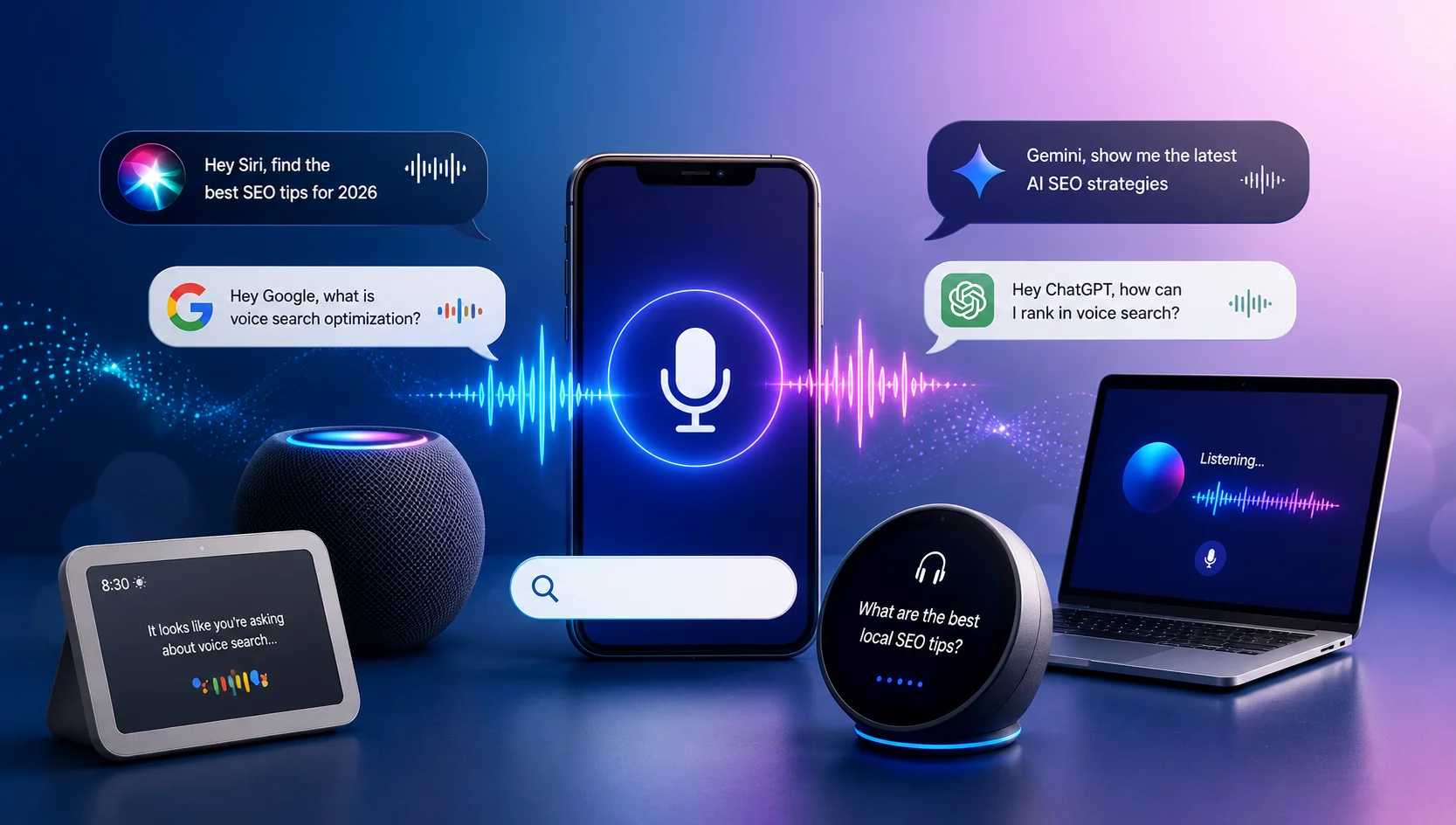

Search has evolved far beyond typed keywords. In 2026, the fastest-growing search method is voice, driven by advanced speech-to-speech AI models like Gemini Live, Apple Intelligence's new Siri, and ChatGPT's Advanced Voice Mode. Users no longer just type fragments; they talk to their devices in fluid, multi-turn conversations. They ask for recommendations, troubleshooting help, and services using natural spoken language—and the AI reads the answer back to them in seconds.
When an AI voice assistant synthesizes an answer, it fetches data from indexed websites in real-time. If your website is not optimized for natural speech processing, structured readability, and conversational context, your business will simply be left out of the conversation. This guide details the structural and technical playbook for Voice Search Optimization (VSO), showing you exactly how to capture this voice traffic in 2026.
Key Takeaways
- Conversational Queries: Voice queries are longer, complete sentences containing natural questions (Who, What, How, Where) instead of disjointed keywords.
- Speakable Schema: Utilizing Schema.org's
Speakablemarkup directly points AI synthesizers to the most read-aloud-friendly sections of your page. - Concise Formatting: The ideal voice search result is 29 to 44 words. Keep answers to heading questions brief and direct.
- High-Intent Local Search: Over 50% of voice searches have local intent (e.g., "Find a web developer near me"). Optimizing your local profiles is crucial.
- Speed and Crawlability: Voice assistants require instant answers. Slow load times or crawl errors mean your site will be bypassed entirely.
What is Conversational SEO & Voice Search in 2026?
Voice Search Optimization (VSO) is the practice of structuring and editing your website's content so that it can be easily understood and read aloud by voice assistants. Unlike text-based search, where a user scans a list of search results, voice search typically yields a single, spoken answer (the "zero result" state).
In 2026, voice search is powered by Large Language Models (LLMs) running speech-to-speech engines. Instead of matching keywords on a page, these models understand the semantic intent of a spoken question, retrieve the most relevant web pages, synthesize a coherent summary, and speak it to the user. This means your content must be optimized not just for search engines, but for verbal communication.
Comparing Traditional SEO vs. Conversational Voice SEO
To win at voice search, you must first understand how user behaviors and search outputs differ between a screen and a speaker. Here is a comparison of the two environments:
| Feature | Traditional Text SEO | Conversational Voice SEO |
|---|---|---|
| Query Length | Short, disjointed (1-3 words) e.g., "Ahmedabad web dev" | Longer, conversational sentences (6-10+ words) e.g., "Who is the best web development agency in Ahmedabad?" |
| Output Format | Search Engine Results Page (SERP) with dozens of links | A single synthesized spoken answer citing 1-2 sources |
| User Intent | Broad research, comparing choices, informational browsing | Immediate action, quick answers, local business discovery |
| Primary Goal | Rank in the top 3 spots to earn user click-throughs | Be the single source selected by the AI assistant for verbal citation |
The 2026 VSO Playbook: Technical & Structural Steps
Optimizing for Siri, Gemini, and ChatGPT Voice requires modifying both the structure of your content and the underlying code of your website. Follow these four steps to adapt your site:
1. Structure Content in Question-and-Answer (Q&A) Format
Since voice searches are formulated as natural questions, your content should mirror this structure. Use subheadings (<h2> and <h3>) to write out common questions your customers ask, and immediately follow them with a direct, clear answer in the paragraph below.
Ensure your direct answers are between 30 and 45 words. This is the sweet spot that LLMs and text-to-speech synthesizers select when reading aloud. It is long enough to provide complete context, but short enough to be spoken in a single breath.
2. Implement Speakable Schema Markup
Google officially supports the Speakable schema markup, which tells search engines and voice assistants which parts of your web page are most suitable for text-to-speech audio rendering. Adding this markup helps assistants identify high-value summary paragraphs instantly.
You can define speakable areas using CSS selectors (like IDs or classes) or XPath inside your JSON-LD script. Here is an example of how to implement it:
{
  "@context": "https://schema.org",
  "@type": "WebPage",
  "name": "SCloud Web Development Services",
  "url": "https://scloud.smit-patel.in/services/web-development",
  "speakable": {
    "@type": "SpeakableSpecification",
    "cssSelector": [
      ".voice-friendly-summary",
      "#key-service-description"
    ]
  }
}
By marking up target elements (such as introduction summaries or callout paragraphs) with these CSS classes/IDs, you significantly increase the chances of voice assistants choosing your text to read aloud to the user.
3. Write for the Ear, Not Just the Eye
When writing articles, read them aloud to check their flow. Text that looks great on a screen can sound robotic, clunky, or confusing when spoken. Keep these principles in mind:
- Use short, punchy sentences: Avoid long run-on sentences with multiple clauses. Voice synthesizers struggle with intonation in overly complex sentences.
- Use simple vocabulary: Avoid jargon, acronyms, or overly technical slang unless you define them instantly.
- Use active voice: Active verbs sound stronger and are easier for listeners to comprehend than passive phrasing.
- Avoid visual-dependent text: Phrases like "as shown in the chart below" do not translate to voice. Provide descriptive, independent text.
"By 2026, search is no longer about matching words on a screen. It is about participating in a live conversation between your customer and their AI assistant. Write your content like you're speaking directly to them."
4. Optimize for High-Intent Local Queries
A huge portion of voice searches are mobile, on-the-go queries with strong local intent: "Find a web development agency near me" or "What is the phone number for SCloud in Ahmedabad?"
To win these local voice searches, you must maintain an immaculate local footprint:
- Claim and optimize your Google Business Profile: Keep your business name, address, phone number (NAP), and operating hours exactly consistent across the web.
- Embed Local Schema: Use
LocalBusinessschema markup on your homepage and contact page to define your exact coordinates, serving areas, and service offerings. - Structure FAQs for local questions: Add questions like "Do you offer web design services in Ahmedabad?" to target region-specific voice queries.
Frequently Asked Questions
How do voice assistants choose their source website?
Voice assistants look for highly authoritative pages that already rank in the top search results for the given query. From there, they prioritize content that answers the question directly within the first few paragraphs, uses clear semantic HTML (headings and lists), and is optimized with structured schema markup.
Is VSO different from Generative Engine Optimization (GEO)?
Yes. While GEO focuses on earning textual citations and links inside written AI search engines (like ChatGPT or Google AI Overviews), VSO specifically targets the spoken, conversational, single-result output read aloud by smart assistants. However, optimizing for one naturally benefits the other as both rely on structured, clear, and high-quality answers. You can read our full guide on how to get cited by AI search for a deeper dive.
Does page load speed affect voice search rankings?
Absolutely. Because users expect instant spoken responses when talking to voice assistants, AI systems prioritize websites that load rapidly and have clean, lightweight code. If your website takes several seconds to respond, voice crawlers will pass it by. Read our article on improving website page speed to audit your site.